Search This Blog

Showing posts with label Archaeology. Show all posts

Wednesday, August 17, 2011

Ancient Board Games & Pieces

Apparently people have enjoyed playing board games for a very long time. It's interesting to find the progenitors of modern board games in Ancient Near East & Egyptian collections. The ancient Egyptian game, Senet, reminds me of a cross between cribbage and Parcheesi. We have a replica in the SS library that can be borrowed. (Directions included!) They used rib bones instead of die, and I've always appreciated that our replica game gives you the choice of wooden ribs or die. I think it's fun for the kids to figure out how many spaces to move by how the "bones" fall. We know a little more about this game, due to representations in tomb art and other ancient references, than we do about other Early Bronze games from the Ancient Near East. There's a Hounds & Jackals peg game in the Ancient Near East room at the Museum of Fine Arts, Boston that closely resembles a cribbage board. Be sure to check it out if you visit. If you would like to read more about ancient games, you may enjoy this site, featuring games played in ancient Nabatea (think Petra) and common throughout the Near East.

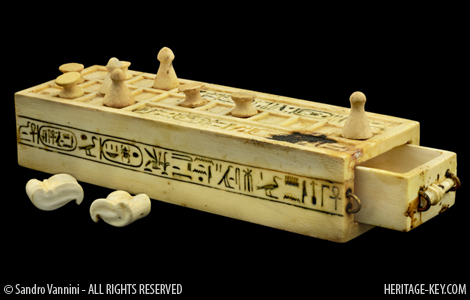
                      Ivory Senet game from the tomb of Tutankhamun (c.1333 BC), Egyptian Museum

Egyptian Hounds & Jackals game, Metropolitan Museum of Art

Ancient Near East game boards and pieces, Early Bronze


                                           Royal Game of Ur (British Museum) [Replica Game]

[Israeli Antiquities Authority website; The British Museum website]

Saturday, June 18, 2011

A Look at Herodium

Shmuel Browns offers an excellent article on Herodium in the April edition of Popular Archaeology, in honor of its excavator, Ehud Netzer, who died last autumn as the result of a fall at the site. Herodium is one of the fortresses built by Herod the Great. (Masada was another such fortress.)  He also built "Lower Herodium" at the foot of the man-made hill. The site is located just outside Bethlehem, on the edge of the Judean wilderness.  It offers spectacular ruins and views from the top.  According to Josephus, Herod built the fortress to commemorate his victory over the Parthians early in his reign. It was destroyed by the Romans in 71 AD.

Professor Netzer had dedicated much of his life to its excavation.  Several years ago he discovered what is likely to be Herod's desecrated tomb on the side of the hill, half way up.  Herodium's proximity to Jerusalem & Bethlehem make it a "must see" should you happen to visit Israel.  The wonder of this article is the opportunity to get a close look at a few of the artifacts and an artist's recreation of what the original area would have looked like. The illustrations are based on the archaeological discoveries made thus far. I love looking at ruins, but I also enjoy being able to imagine what it once looked like in its prime. Enjoy the article! [If you right-click on most of the pictures in the article, and choose "view image," you'll get a large photo to look at.]

Thursday, June 02, 2011

Ennion Glass on Exhibit

The Israel Museum just opened a special exhibit of mold-blown glass from the Roman Empire, including many pieces of 1st Century AD Ennion glass from a private collection. I understand this is the largest display of Ennion's work ever available for public viewing.  The Getty offers the following information concerning the artisan, Ennion. If you happen to visit Israel before the end of January 2012, be sure to take advantage of seeing this exhibit! [Click on each photo for a close-up look.]
"Ennion worked as a glassmaker about 1 to 50 A.D. His signature is known from over thirty surviving pieces, and many other works are attributed to him on the basis of style. Ennion created the ground-breaking technique of blowing glass vessels into molds. This new process allowed the vessel and its decoration to be created at the same time and permitted the creation of multiple copies of the same vessel. Ennion's clear, precise designs distinguish his work; he also minimized the visibility of the lines caused by the seams in the mold.
The location of Ennion's workshop is debated, in part because his work is found throughout the Roman Empire. Some scholars believe he worked in Sidon in modern Lebanon, while others assert that he worked in northern Italy. The inscriptions he frequently used as decoration may provide a clue. Though his name may have been Semitic in origin, he signed it in Greek, the language of the eastern Mediterranean, not Italy. The city of Sidon, where he may have worked, had all the raw material for glass-making and extensive trade connections." 

Tuesday, April 12, 2011

New Excavation to Start at Carchemish!

Carchemish [Karkamış] was an ancient city of the Mittani, Hittite and Neo-Assyrian Empires.  Occupation dates back to the Neolithic period, with pottery finds from ca. 3000 BC and tombs from ca. 2300 BC.  The site is on the border of modern Turkey & Syria. The tell is currently located on the Turkish side, just west of Ancient Haran, where Abraham first settled after leaving Ur of the Chaldees (Gen.11-12). [Also the site where his father died (Gen.11:32) and the city where Jacob's mother Rebekah & her brother Laban resided (Gen.27:43).]  SW of Carchemish is the ancient city of Alalakh, which our Women's Bible study may remember. [Click on the map for a closer look.]


Carchemish was a large and significant city throughout ancient history,  originally controlling the main ford across the Euphrates.  Mention of the city has been found in ancient Egyptian, Assyrian & Babylonian texts, as well as in several Old Testament passages.
  • Isaiah made a reference to Carchemish (Isaiah 10:9). The city had been sacked by Sargon II of the Neo-Assyrian Empire in 717 BC.
  • Pharaoh Necho of Egypt went up to Carchemish to help defend the  Assyrians against the encroachment of the  Babylonians, led by Nebuchadnezzar II, in 609 B.C. (2 Chronicles 35:20; Jeremiah 46:2). King Josiah of Judah (the "boy King" grown up) tried to stop him, but was killed.  The subsequent Battle of Carchemish between the Egyptian/Assyrian coalition & Nebuchadnezzar's Babylonian forces is well documented.  Babylon defeated the Egyptians & the Assyrians, absorbing the Neo-Assyrian Empire into the Neo-Babylonian Empire. Nebuchadnezzar then went on to conquer Judah and Jerusalem in 605 BC.
The site of ancient Carchemish was identified by George Smith in 1876 and excavated by British archaeologists Leonard Woolley & T.E. Lawrence.  In recent times it has been a military zone and off limits to archaeologists, but the area was just cleared of 1200 land mines and a new excavation is scheduled to begin this year!

[Read news story here. From: Ferrell Jenkins blog.]

Wednesday, March 09, 2011

"Tekhelet" Colored Dye Found at Masada

For the first time an ancient example of a textile dyed with the Hebrew color tekhelet was discovered in a 1st Century AD fabric scrap found at Masada. It's much darker and more of a "blue" hue than I had imagined! Biblical Archaeology Review gives the following report on their blog...

"A scholar studying preserved textiles from first-century C.E. Masada has identified the precise shade of the mysterious and long-debated Biblical color tekhelet. The Bible often mentions tekhelet as the color of royal garments and priestly robes, and in later times, it colored the tasseled fringes, or tsitsit, of Jewish prayer shawls.

While Jewish tradition generally associated the color with the bluish dye produced from the secretions of Murex snails, no clear examples of tekhelet from Biblical antiquity had been found...until now. In studying a piece of 2,000-year-old embroidery from Masada, Israeli scientist Zvi Koren analyzed a distinct bluish-purple, almost indigo patch of dye and found that it had clearly been produced from the ancient Murex snail."

BAR blog, March 2 post

Friday, March 04, 2011

Zahi Hawass Resigns ... and Is Reappointed...and is Removed!

Zahi Hawass, Egypt's Minister of Antiquities Affairs, has resigned following the political upheaval in Egypt with its related looting of antiquities sites... more widespread than we had realized, which so upsets me. If you've ever watched a PBS documentary or a video on Ancient Egypt or read an article in National Geographic or been informed of a tomb find on the Evening News, you've seen Zahi Hawass. His is the most visible face in Egyptian archaeology... almost embarrassingly so. I can't even recall an article, documentary or news story on Ancient Egypt without his face appearing in my mind!


Kate Taylor reports the following at the NY Times Art Beat blog.
Zahi Hawass, Egypt’s powerful and controversial antiquities chief, resigned on Thursday along with the prime minister, after posting on his Web site for the first time a list of dozens of sites that have been looted since the beginning of the uprising that led to the fall of President Hosni Mubarak.

Among the places Mr. Hawass named as having been looted were the Metropolitan Museum of Art’s storerooms at its excavation site in Dahshur, south of Cairo. In a statement the Met’s director, Thomas P. Campbell, described that incident as having taken place several weeks ago. Mr. Campbell expressed alarm about continuing looting, calling it “a grave and tragic emergency.” In a statement, which was issued before Mr. Hawass’s resignation was confirmed, he said:
         “The world cannot sit by and permit unchecked anarchy to jeopardize the cultural heritage of one
         of the world’s oldest, greatest and most inspiring civilizations. We echo the voices of all concerned
         citizens of the globe in imploring Egypt’s new government authorities, in building the nation’s future,
         to protect its precious past. Action needs to be taken immediately.”

Dr. Hawass' blog

Sunday, December 12, 2010

A Few Surprises in Cleveland!

I thought I would share a few significant antiquities from the collection at the Cleveland Museum of Art. As I descended the stairs to the antiquities area, I was shocked to discover a full sized bronze statue from Classical Greece staring at me. Greek bronzes are extremely rare. Most of our knowledge concerning them comes from their more recent Roman copies. (The Romans loved Greek culture!)  The only original bronzes I have ever seen were those discovered in a sunken ship off the coast of Greece and placed on display in a small museum in Piraeus, the port of Athens. And here was one in the collection at Cleveland! It's called "Apollo Sauroktonos (Lizard Slayer)" and depicts a youthful Apollo, holding an arrow, about to stab a lizard climbing the tree he's leaning against. The tree & arrow are gone. Other than that the statue is in wonderful condition. It's attributed to Praxiteles himself (400-330 BC). The eyes are made of stone. It's even more unusual for the eyes to be intact. The viewer has a vivid idea of how this statue actually appeared to the Greeks in the 4th century BC! This is a real treasure!

In the Ancient Near East collection I was also surprised to find a few other treasures. There are a number of ancient stone figures from the Greek Cyclades islands dating to c.3000 BC that seem almost modern in their simplicity of line & feature (see example on left). They're referred to as "Cycladic" art and I've only seen examples which came from this group of Greek islands in the Aegean. [The Benaki Museum in Athens has an excellent collection.] Well, it appears that Cleveland has one of similar style from the same time period which was found not in the Cyclades islands, but in Western Anatolia (modern Turkey)! No mythology has yet been found to go with these statues, but I suspect they were cultic in nature, probably representing a fertility goddess. The one in Cleveland is not identical to the Cyladic examples, but very close in style! (See Cleveland's "Star Gazer" on right.) One difference is that the head looks up in the Cleveland statue. The Cycladic statues usually have a straight-forward gaze. It's easy to imagine trade and exchange of ideas and culture between the Greek islands & Anatolia, even in 3000 BC. This truly fascinated me.

And finally, I was thrilled to discover finds from an "old friend". Mystery writer Agatha Christie's second husband, Max Mallowan, was an eminent British archaeologist. She accompanied him on digs in the Near East just before and after WWII and wrote about the experience in one of my favorite books, Come, Tell Me How You Live. It's a wonderful read and gives a fascinating depiction of the Near East in that time period. Mallowan is well known for his discovery of a number of small ivory carvings he found in a well in the ancient Assyrian city of Nimrud (modern Iraq). Since they were detached from the furniture where they originally appeared, it's probable they were part of the loot taken by an Assyrian king from some Near Eastern palace. [They are carved in a Phoenician (modern Lebanon) style.] They had been tossed into the well, perhaps  during a subsequent attack of Assyrian Nimrud, and there they remained until discovered by Mallowan. A number are on display at the British Museum and others can be seen in the National Museum in Iraq. Good news, friends... some of them can also be viewed at the Cleveland Museum of Art! I walked around a corner and came upon an entire display case of them! Breathtaking and so unexpected. Unfortunately, I don't have a photo of the ones from Cleveland, but here are a few examples found in other museums. This is a peek into the Ancient Near Eastern world we read about in the Old Testament!

Monday, February 09, 2009

The Great Scroll of Isaiah


While visiting the Shrine of the Book Museum in Jerusalem a year ago, I quickly hurried downstairs to look at the Great Isaiah Scroll, found among Qumran's Dead Sea Scrolls. Probably your eyes are glazing over and you're stifling a yawn... but consider this. How many ancient versions of Scripture are ever on display to the public? Almost none. The earliest portion I had ever seen was a scrap from the Gospel of John dating to the early 2nd Century AD on display at the British Library in London.

My hopes of seeing the Isaiah scroll were dashed as soon as I realized I was looking at a replica. The original is kept in a climate-controlled, bombproof vault and only small portions are ever put on display. [I believe Beth was able to see one in a special exhibit that toured the US.] If I had waited until summer, I could have seen a large portion that was placed on display at the Shrine of the Book in honor of Israel's 60th anniversary.

You may not appreciate the significance of this scroll to the preservation of Scripture. Dating to ca. 120 BC, it is by far the oldest complete copy of any biblical book. Our modern English versions of the OT are based upon the Masoretic texts, which came from a school of scribes and Torah scholars working from the 7th-11th Centuries AD, based in the cities of Tiberias, Jerusalem and Babylonia.

The Great Scroll of Isaiah found among the Dead Sea Scrolls (120 BC), is nearly identical to the Masoretic version of the Book of Isaiah (7th-11th Centuries AD). Even though 1000 years separates the two texts, the differences between them are amazingly minor! That should give us confidence in the accuracy of the texts used to translate our modern Old Testaments. What other ancient literature can even come close to claiming that?!

Saturday, January 17, 2009

Always Changing Jerusalem


When someone visits Israel for the first time, it can be easy to imagine that the historical areas have always looked the way you are seeing them. But modern Israel is about 20 feet above where it would have been during Jesus' day. Here are two photos of the Western Wall of the Temple Mount. The top picture was taken in 1964. Note the large crack in the stone behind the man's knees.

The Western Wall Plaza has been lowered about 6 feet since then. The bottom picture shows how it looks today. Note the same cracked stone under the right hand of the young man in the red shirt who is standing on a chair. I found this to be a wonderful visual reminder of the constant changes Jerusalem is undergoing.

[I found these two photos on Todd Bolen's website. The top photo was taken by David Blevin and the bottom one by Todd.]

Thursday, May 10, 2007

Herod's Tomb

By now you've likely heard about the recent discovery in Herodium of what is thought to be the tomb of Herod the Great. The archaeological world has been expecting it to be found at this site...they just didn't know exactly WHERE. Herod built a fortress-palace in Herodium, one of his many amazing building projects. He also built a city, Lower Herodium, at the bottom of the hill. Sections of the city have previously been excavated, including a synagogue and mikveh for ritual bathing.

Ehud Netzer has been working at this site for over 35 years. Herod's probable tomb was found on the side of the hill, quite low down. Netzer speculates that the podium [approx. 32' x 32'] once supported a Mauseleum, with the actual tomb located beneath. Architectural elements of such a Mauseleum, dated to Herod's time and of "kingly" quality, were found.

The sarcophagus inside the tomb was found smashed into pieces. Any identifying inscriptions did not survive the desecration. Vengeful participants in the First Jewish Revolt against Rome were known to have destroyed the tomb and sarcophagus about 70 years after Herod's death.

The chances of now finding definitive evidence to positively link the tomb to Herod the Great are pretty unlikely. But the probability is quite high that this was indeed where he was buried. I came across some of Netzer's pictures and thought you might like to see some "close-ups" of the find. Most shots I've seen in the media have been archive footage of Herodium. Enjoy this sneak peek of the actual find!

Friday, March 16, 2007

Archaeological Tidbits


I just received my quarterly issue of "Artifax", which gives an interesting overview of current archaeological stories in the news. Here's a sampling:

In Luxor [think Karnak & Valley of the Kings] they recently discovered facilities belonging to Cemetery Workers, near the Rameseum [the Mortuary Temple of Rameses II; see picture]. It includes kitchens, ovens and a school for children, as well as their own nearby cemetery. [Yes...a cemetery for Cemetery workers... ;)] I always find it interesting when they find something dealing with the average guy.

At Qumran a dig by the Univ. of N.C. at Charlotte has discovered a latrine site that would seem to backup the suggestion that Essenes lived in this community. [There's been a lot of debate about this. Recently a group has suggested Qumran was a pottery factory.] According to Josephus & others, the Essenes made it a practice to locate their latrines at a distance from and out of site of the village. [It makes you feel bad for the guy who had to go in the middle of the night! I wonder if they used chamber pots?] Anyway, this latrine site meets those requirements. And you'll be thrilled to hear that they found intestinal round worms, tapeworms, whipworms and pinworms. Apparently the Essenes, in their desire for cleanliness, required human waste be covered (little shovels provided to all), which actually contributed to the survival of intestinal worms...and their spread. Medieval Arabs, on the other hand, did not bury their waste, leaving it out in the open, where the worms quickly died. That's ironic, don't you think?

Saturday, March 03, 2007

Cameron Plays Science


These two articles say more than I could about James Cameron, et. al. [Thanks to Todd Bolen for bringing them to my attention on his blog...] I love the line, "Television is not in the business of education... they're in the business of making money." Let's not forget that! [Btw, this is a shot of the ossuary of Joseph son of Caiaphas, also found in Jerusalem.]


From Atlanta Journal-Constitution:
Modern architects of fantastic finds try to provide an air of legitimacy by invoking scientific jargon, said Garrett G. Fagan, a classics professor at Penn State University and author of, "Archaeological Fantasies: How Pseudoarchaeology Misrepresents the Past and Misleads the Public" (RoutledgeFalmer, $46.95).
"They're not scientists, but they need to dress themselves in the clothes of science to pass muster," Fagan said. Some choose prestigious channels that style themselves as vehicles for public education, he said. "Television is not in the business of education, even with the so-called educational channels like Discovery," Fagan said. "Ultimately, they're in the business of making money."

And when critics pounce on the discoveries, Fagan said it's often too late.
"By the time the rebuttals come out, the mass media would have moved on to the next sensation," Fagan said, "and people will have this vague notion that they have found the tomb of Jesus." Fagan said he expects more fantastic archaeological discoveries to be announced in the near future.
"Someone is going to say they've discovered Moses' beard," he said.

From the Washington Post:
Jodi Magness, an archaeologist at the University of North Carolina at Chapel Hill, expressed irritation that the claims were made at a news conference rather than in a peer-reviewed scientific article. By going directly to the media, she said, the filmmakers "have set it up as if it's a legitimate academic debate, when the vast majority of scholars who specialize in archaeology of this period have flatly rejected this,'' she said. Magness noted that at the time of Jesus, wealthy families buried their dead in tombs cut by hand from solid rock, putting the bones in niches in the walls and then, later, transferring them to ossuaries. She said Jesus came from a poor family that, like most Jews of the time, probably buried their dead in ordinary graves. "If Jesus' family had been wealthy enough to afford a rock-cut tomb, it would have been in Nazareth, not Jerusalem,'' she said. 

Magness also said the names on the Talpiyot ossuaries indicate that the tomb belonged to a family from Judea, the area around Jerusalem, where people were known by their first name and father's name. As Galileans, Jesus and his family members would have used their first name and home town, she said. "This whole case (for the tomb of Jesus) is flawed from beginning to end,'' she said.

Tuesday, December 12, 2006

Mesopotamian Creation Myths, Part 1


The earliest Mesopotamian text, found thus far, having parallels with Genesis is a copy of the "Atrahasis Epic", dated to the 17th Century BC, from a story dating back centuries EARLIER. The story is presented from the theological perspective of the Old Babylonians [OLD Babylonian Period c.2000-1600 BC / NEO-Babylonian Period 625-539 BC, Nebuchadnezzar's time]. The story has details which appear to be corrupted versions of the Genesis account:

* The gods rule the heavens and the earth [Gen.1:1 "In the beginning God..."]

* The gods make man from the clay of the earth mixed with blood. [Gen.2:7, 3:19; Lev.17:11] for the purpose of taking over the lesser gods' chores of tending the land [Gen.2:15]

* When men multiply on the earth and become too "noisy" ;), a flood is sent (after a series of plagues) to destroy mankind. [Gen.6:13]

* One man, Atrahasis, is given advance warning of the flood and told to build a boat. [Gen.6:14]

* He builds a boat and loads it with food and animals and birds. Through this means he is saved while the rest of the world perishes. [Gen.6:17-22]

At this point the text is destroyed, so there's no record of the boat landing. However, the very end of the story HAS been found - it ends with Atrahasis offering a sacrifice to the gods and the chief god accepting mankind's continued existence. [Gen.8:20-22]

The literary style, of course, is completely different from the Genesis account and to even suggest that the Genesis story was copied from the Mesopotamian story only demonstrates you've never read the two accounts! Also, missing from the Atrahasis Epic is any kind of love of the gods for men (they are pretty much viewed as useful slaves, as long as they don't get too "noisy") or any element of morality, which are the warp and weft of Biblical accounts. Those two points hold true whenever you compare pagan writing with the Bible. But I believe it DOES demonstrate that both refer to events that were once commonly known.

Saturday, November 18, 2006

Ancient Egyptian Creation Myths


I'm always fascinated while studying early civilizations to find "pieces" of Truth buried in their myths. Creation myths are of particular interest. Some of you may be familiar with the Mesopotamian 'Enuma Elish'. The Greeks, btw, incorporated Mesopotamian mythology when developing their own. [I know that may come as a shock to the Greeks, who have a national belief in Hellas being the source for ALL civilizations, a POV reaching back to the time of Herodotus! ;) The world DID receive much from the Greeks...but not everything originated with them.] None of these creation myths, btw, hold a candle to the presentation in Genesis. While there are similarities, the differences are absolutely GLARING! I attribute the similarities to their having had an original knowledge of the Truth. [Romans, Chapter 1] And I find it's a universal phenomona - even reaching to the Americas.

When considering Ancient Egypt we sometimes lose sight of the variations of beliefs over their 3000 years of existance- it varied according to regions and time periods. So I thought I would tell you about four of their creation myths.

Heliopolis: The self-created Atum-Ra (the sun) emerged from the primeval ocean, Nun, and produced the divine pair Shu (air) and Tefnut (moisture) [2nd Day Division of Firmament & waters?]. They, in turn, became the parents of Geb (earth) and Nut (sky), who were in turn the parents of the four primary gods: Osiris and his wife Isis, Seth and his wife Nephthys. This system of nine gods ["The Ennead"] became the dominant view, and was centered in Heliopolis [Biblical "On"; "Heliopolois" is its Greek name...there go those Greeks again ;)], just north of modern Cairo].

Hermopolis: Eight shadowy gods (including Amon, "The Hidden One") produced out of the formless watery waste an egg, from which the sun (Atum-Ra) emerged.

Memphis [So. of Modern Cairo; residence of the Pharaohs during time of Abraham]: All things originated as thought in the heart of Ptah and issued through the commands of his tongue. [Sound familiar?]

Elephatine: Mankind was shaped by the ram god, Khnum, on his potter's wheel.

Next Post I'll tell you a few of the Mesopotamian Creation myths.

Monday, August 14, 2006

"No Evidence" - Really?

If you haven't done much reading in the field of archaeology, you may not be aware of the raging controversies. There is no such thing as "Archaeologists believe...", because they are NOT a unified group. The Biblical evidence concerning events in Genesis 37 to Exodus 14 has been spurned by those with reductionist tendencies, because they believe them to be "ideologically and theologically shaped". [Now many of these same "reductionists" become quite "maximalist" when evaluating NON-biblical sources. There's a real lack of consistency in examining ancient literature, with the Bible seldom accorded the same respect as other ancient works, even though Biblical integrity is far above that of other documents from the same time periods. This doesn't come as a great surprise, but it does seem smack of intellectual dishonesty.]

The "official" reason usually given for discounting the Biblical record is that no historical or archaeological evidence has been found to back it up. I guess that would depend how fine a definition you use...and how patient you are for archaeologists to officially write up the results of their findings. There IS evidence there were Semites in Ancient Egypt's Eastern Delta from the end of the Old Kingdom (ca.2160 BC) to the height of the 108 year reign of the Hyksos (ca.1648-1540 BC) and the entire Second Intermediate Period (ca.1786-1550BC) , and even into the New Kingdom (ca.1550-1069 BC). To an ancient Egyptian, "Semites" would include Syrians, Arab Bedouins and Hebrews. To try to break it down any further would be pretty tough, though I believe there ARE some distinctive Hebrew artifacts, such as pottery. But it's not likely they will ever find a diary entitled "Joseph, the Hebrew, and Me". ;) [Btw, I believe Joseph entered Egypt during Dynasty 12 and the Exodus was ca. 1446 BC, maybe during the reign of Amenhotop III, Dynasty 18.]

Existing epigraphic evidence includes such works as "The Instruction for Merikare" [Dynasty 10, ca.2106-2010 BC - the time of Abraham. Remember he went to Egypt due to a famine in Canaan? Apparently he was not the ONLY one to do so.]. Egyptians referred to the residents of Syro-Palestine as "Asiatics" and "bowman" (meaning foreigner), a synonym. The cited document states "The east (Delta) abounds with foreigners" and complains that "these foreigners...the miserable Asiatic" had infiltrated the eastern Delta region.

"The Prophecy of Neferti", likely written during Dynasty 12, the time of Joseph, discusses conditions during the First Intermediate Period. "Asiatics" are referred to metaphorically: "A strange bird will reproduce in the marsh of the Delta, having made its nest by the people" and "those feeders, Asiatics who are throughout the land" and "Asiatics have come down to Egypt". There's also a document from Thebes called the "Papyrus Brooklyn 35.1446" from the late 12th/early 13th Dynasty containing a ledger of servants on just ONE Egyptian estate. Over 40 are labeled as "Asiatics" and have Syro-Palestinian names! [Joseph was a servant on an Egyptian estate, remember?]

In the next post I'll get into some of the archaeological evidence for Semites residing in Ancient Egypt.

Thursday, August 10, 2006

A Ring and A Curse

In the Summer issue of Britain's "National Trust Magazine" there was an interesting article about two "finds" in Britain that might have ended up having particular significance. In the late 18th Century a farmer found an engraved gold ring from the 4th-5th Century at the remains of the Roman town of Silchester. The ring has a chunky bezel with an engraving of Venus and engraved letters surround the band, which is in the shape of a ten-sided hoop. By amazing coincidence, a few decades later a Roman lead tablet bearing an inscription concerning this ring was found at a Roman temple site at Lydney in Gloucestershire. The tablet was engraved with a curse imprecating woe upon the person who had stolen this very ring! [Written curses left at temples must have been quite common. I remember seeing many examples uncovered at the temple connected to the Roman baths at Bath. Interestingly, people they wanted to curse were often mentioned by name, along with the wrong they had committed! (No "forgive and forget" in THOSE days!) At Bath they were usually written upon ostraca, broken pieces of pottery.]

Then in 1928 Sir Mortimer Wheeler, a prominent archaeologist, was told of the ring and the "curse tablet" while he was excavating at Lydney. Wheeler had an advisor on his Lydney dig who was an expert in early English - an Oxford don, named Tolkein! Was it inspiration, do you think?