Search This Blog

Showing posts with label Ancient History. Show all posts

Wednesday, August 17, 2011

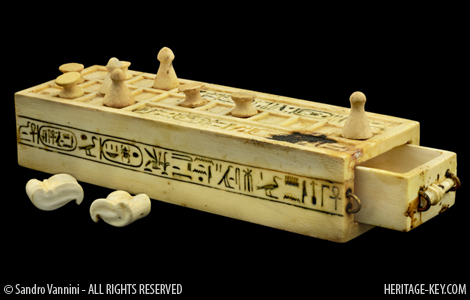
Ancient Board Games & Pieces

Apparently people have enjoyed playing board games for a very long time. It's interesting to find the progenitors of modern board games in Ancient Near East & Egyptian collections. The ancient Egyptian game, Senet, reminds me of a cross between cribbage and Parcheesi. We have a replica in the SS library that can be borrowed. (Directions included!) They used rib bones instead of die, and I've always appreciated that our replica game gives you the choice of wooden ribs or die. I think it's fun for the kids to figure out how many spaces to move by how the "bones" fall. We know a little more about this game, due to representations in tomb art and other ancient references, than we do about other Early Bronze games from the Ancient Near East. There's a Hounds & Jackals peg game in the Ancient Near East room at the Museum of Fine Arts, Boston that closely resembles a cribbage board. Be sure to check it out if you visit. If you would like to read more about ancient games, you may enjoy this site, featuring games played in ancient Nabatea (think Petra) and common throughout the Near East.

                      Ivory Senet game from the tomb of Tutankhamun (c.1333 BC), Egyptian Museum

Egyptian Hounds & Jackals game, Metropolitan Museum of Art

Ancient Near East game boards and pieces, Early Bronze


                                           Royal Game of Ur (British Museum) [Replica Game]

[Israeli Antiquities Authority website; The British Museum website]

Wednesday, August 10, 2011

Tang Dynasty Horses

Earlier this week I enjoyed spending the morning at the Museum of Fine Arts, Boston with my oldest grandson, Nehemiah. On the way home he declared that he and I were "museum buddies," which truly warmed his Nana's heart! When I asked what his favorite work had been, he said he liked the Tang horses best. He's almost 5 and doesn't understand much about time and ancient history, but is able to connect with certain works, which greatly pleased me. I was particularly surprised when, unable to find a certain painting by Millet shown in his book, he pointed to another work by Millet on display and said, "There's another one of his paintings." Good eye, my boy! It will be interesting to see how his interest develops.


The Tang Dynasty horses, from the early 8th Century AD, have been popular with a number of children I've brought to the MFA over the years. This may be partially due to their resemblance to several famous "Disney" horses. Since I first saw them I have been convinced that the Disney artists were often inspired by ancient Chinese drawings and ceramics. The Chinese camel ceramics also have a familiar look about them.

I thought you might enjoy taking a look at these magnificent creatures. They are quite large, almost 2 feet tall and, as Nehemiah noticed from his low vantage point, they are hollowed out. (Take a look under their stomachs if you happen to see any at a museum.)

You can take a little self tour of some of the images of horses from the MFA in various mediums by clicking here. Enjoy!
If this area interests you, I'd recommend looking for a copy of "Imperial China: The Art of the Horse in Chinese History". Amazon has reasonably priced used copies. (Click on a photo for a closer look.)


Look familiar?

Saturday, June 18, 2011

A Look at Herodium

Shmuel Browns offers an excellent article on Herodium in the April edition of Popular Archaeology, in honor of its excavator, Ehud Netzer, who died last autumn as the result of a fall at the site. Herodium is one of the fortresses built by Herod the Great. (Masada was another such fortress.)  He also built "Lower Herodium" at the foot of the man-made hill. The site is located just outside Bethlehem, on the edge of the Judean wilderness.  It offers spectacular ruins and views from the top.  According to Josephus, Herod built the fortress to commemorate his victory over the Parthians early in his reign. It was destroyed by the Romans in 71 AD.

Professor Netzer had dedicated much of his life to its excavation.  Several years ago he discovered what is likely to be Herod's desecrated tomb on the side of the hill, half way up.  Herodium's proximity to Jerusalem & Bethlehem make it a "must see" should you happen to visit Israel.  The wonder of this article is the opportunity to get a close look at a few of the artifacts and an artist's recreation of what the original area would have looked like. The illustrations are based on the archaeological discoveries made thus far. I love looking at ruins, but I also enjoy being able to imagine what it once looked like in its prime. Enjoy the article! [If you right-click on most of the pictures in the article, and choose "view image," you'll get a large photo to look at.]

Monday, June 18, 2007

Proverbial Sayings


When we consider modern English language, many idioms and proverbial sayings come to mind. For a person raised in THIS culture and time period, such figurative language presents no obstacle to understanding. But if you are an immigrant to whom English is a second language, it can cause a great deal of confusion. I have a friend from Taiwan who showed me a book she had brought with her to the US, entitled "American Idioms", written by a man whose primary language was Chinese. There were many, many errors in his book, some of which would have been incredibly embarrassing to have repeated in public! I suggested that she throw the book away and just learn them as she comes across them. Even within the United States there are various regional idioms and proverbial sayings unknown to the general population.

Now consider the Bible. We are removed 2000+ years from the time and thousands of miles from the cultures. Yet we often forget to take that into consideration when studying our Bibles. I find myself expecting that everything written in the Bible is totally unique apart from its time and cultures. Yet if we think about it, we should realize that time and culture were just as much used by the HS as each author's individual writing style and vocabulary were.

This can take on particular significance when applying the Grammatical-Historical method of interpretation. This literal method of interpretation takes into account the use of figurative language - metaphors, poetry, idioms, proverbial sayings, etc. But if you don't recognize something as figurative, you could easily misinterpret it literally.

For example, if I became frustrated trying to work on a project and laughingly said, "I think I'll just shoot myself", you would know that I'm laughing at my frustration. But if you didn't HEAR my laugh or tone of voice and you didn't pay attention to the CONTEXT in which I used the phrase, you might become concerned that I was threatening suicide. You can see how easy it can be to misunderstand the figurative use of language.

One of the advantages of reading "old stuff" is that in ancient writings I am always coming across material in non-biblical sources that I had previously assumed to be completely unique to the Bible. Suddenly a light bulb will come on and I'll understand that the biblical author was using a common proverbial saying or idiom from his time and culture to clarify his biblical point. If I don't understand that in my interpretation of the passage, I may erroneously put the emphasis in the wrong place - and miss the REAL point all together.

Recently I've been reading Plato. [It's another "Greek summer"! ;)] Today I came across two proverbial sayings that sounded very, very familiar to me and resulted in my reconsidering the biblical passages where they are used.

For example, Mark 9:43, 45 says:
Mar 9:43 And if your hand causes you to sin, cut it off. It is better for you to enter life crippled than with two hands to go to hell, to the unquenchable fire.
Mar 9:45 And if your foot causes you to sin, cut it off. It is better for you to enter life lame than with two feet to be thrown into hell.

Now if I interpreted that literally, I would be handless and footless by now! Fortunately, for most of us, common sense would tell us that Jesus is not teaching that we are to literally cut off a hand or foot, but he is using figurative language to teach the point of the heinousness of sin. I'm relieved that I have interpreted it this way, because I just happened to come across the very same proverbial saying in Plato's (431BC-351BC) "Symposium":
"And they will cut off their own hands and feet and cast them away, if they are evil"

What do you know? Jesus was repeating an ancient Mediterranean proverb to teach a point!! [Good thing I held off on the self mutilation!]

Here's another, less drastic, proverbial saying:
Mat 5:13 "You are the salt of the earth, but if salt has lost its taste, how shall its saltiness be restored? It is no longer good for anything except to be thrown out and trampled under people's feet.

Plato, in "The Republic", in reference to the education of the Philosopher-King, writes:
"For wherewith shall it be salted if the salt have lost its savor?" The point is ... if something lacks its purpose, it's good for nothing. The context of Mt.5:13-16 makes it easy to now understand Jesus' meaning. If a follower of Christ doesn't have good works that glorify the Father, then they are worthless ... like salt that doesn't taste salty or a light that doesn't shine.

I guess the moral is to constantly remind ourselves that such figurative language, as well as possible quotes from works familiar to the original readers, existed. I think I will start keeping a list of them as I read through ancient writings. In the meantime, probably the best thing we can do to avoid major errors in interpretation is to -

(1) Be humble in realizing there is more to Bible interpretation than we may at first consider

(2) Read the Bible slowly, thoughfully and repeatedly

(3) CONTEXT, CONTEXT, CONTEXT

(4) Try to determine the MAIN POINT the author is making, rather than getting too bogged down in the figurative language or even with a specific cultural practice that is only reflecting that main point

(5) Read more "old stuff"

Monday, April 30, 2007

epichorēgeō Your Faith

2Peter 1:3-7 gives us another Biblical example of the partnership involved in the Christian walk. [Also see Phil.2:12-13] After being informed of what God has supplied, the believer is then exhorted to "add to/furnish" his faith. The verb translated "add to/furnish" is epichoregeo. This fine old Greek word introduces the metaphor of the Choregos of Classical Athens.

The ancient world was totally alien from our modern view of culture, religion and politics. That sounds almost simplistic, but it's amazing how we tend to forget this when reading our Bibles! Civic, cultural and religious life were inextricably linked. There was no separation of church and state. There was no sense of "individualism" or "self determination". Membership in a particular city-state was the key component of their lives. Greek drama was presented as a part of the religious celebrations during various festivals. Wealthy patrons would be the ones to finance these endeavors. Such acts of generosity were viewed as an important factor in being a citizen of a particular polis. The Choregos was the patron who donated the money to finance the chorus. [The purpose of the chorus was to explain things to the audience and interact with various characters. They were a vital element in a Greek play.] In recognition of such magnanimous behavior, the Choregos was often honored with a monument, bearing appropriate inscriptions. This is a picture of such a monument in Athens. It's located just below the Acropolis, on the sides of which were the two primary theaters of Classical Athens.

The word eventually came to mean "generous and costly co-operation". Peter uses it to exhort the believer to engage in a cooperative effort with God that will result in a Christian life that glorifies Him. Do we view OUR Christian walk in this manner? Are we "generous" and making a "costly cooperative effort" to display a Christian walk that glorifies God? I think understanding the meaning and history of this one verb adds an important element to our understanding of Scripture!

Tuesday, March 20, 2007

"Just the Facts, Maam"


I've been reading "Associations, Synagogues and Congregations" by Philip Harland, Asst. Prof. of Christian Origins at Concordia University in Montreal, Canada. It's a secular book examining the sociological aspects of 1st/2nd Century AD Graeco-Roman society in the East [primarily Asia Minor], via inscriptions and literature from that period. In general, I have avoided such sociological interpretations, mainly because of my educational background in Sociology. I find much of Sociology is based upon sheer speculation, rather than hard evidence. There's also an annoying tendency by modern sociologists to incorrectly apply modern sociological models to ancient societies. On the other hand, most of what is considered "Christian" literature is seldom backed up by any actual evidence either. Rather, there's a propensity to quote other Christian authors (who in turn are quoting still other Christian authors) as evidence, rather than looking for primary sources [archaeological, epigraphical, inscriptional, etc.] - such information ultimately ends up in Commentaries and study Bible notes, resulting in the perpetuation of false analyses from pulpits and in Bible studies. And that, unfortunately, greatly hinders an accurate understanding of the Bible.

An example of this would be a "proof" frequently cited concerning the corruption of 1st Century AD Corinth - the alleged practice of widespread temple prostitution connected to the Temple of Aphrodite on Corinth's acropolis [the Acrocorinth - see picture]. I've run across this in numerous Commentaries and study Bibles... but it's just not true! This assertion turns out to be based upon ONE sentence in ONE ancient writing - by Strabo (writing in the 1st Century AD) about a story he HEARD from someone concerning an alleged practice which supposedly occurred during archaic times in Greek Corinth. Ancient writers like Strabo and Herodotus didn't write "history" in the manner of modern historians. They included every story anyone ever told them - some of which may have been true or partly true, but much of which was fictional, or at least mythologized.

Even IF there had been such a practice in archaic times, which would have been contrary to practices everywhere else in archaic Greece, it certainly wasn't true by the 1st Century AD. The Romans under Lucius Mummius completely destroyed Greek Corinth in 146 BC. The city lay in ruins until Rome, under Julius Caesar, rebuilt it in 44 BC (102 years later!) and repopulated it with Roman veteran military colonists (as they also did in Philippi, btw). Greeks, Jews and Asiatics also settled there, but 1st Century AD Corinth was primarily a Roman city (as was Philippi). There was still a Temple of Aphrodite on the Acrocorinth in Paul's time, but it was much, much smaller [10 x 16 meters] and much less significant than in archaic times. The Roman colonists built temples more important to them - to Apollo, Athena Chalinitis, Poseidon, Herakles, Hermes, Venus-Fortuna (a very Roman version of Aphrodite) and Asklepios.

Were there prostitutes in Corinth? Absolutely. Paul speaks of it in 1Corinthians. Every Roman city had brothels, whether on Italian soil [Pompeii] or Provincial soil [Ephesus]. Nor was it unusual for men to use one of their own slaves in this capacity. [Some of whom actually ended up marrying their masters! We know that because of funereal inscriptions, giving considerable detail about the deceased's personal life.] But there is absolutely NO proof that there was temple prostitution in 1st Century AD Corinth. Not even Strabo suggested that! There are indications in some cities that particular temples may have owned slaves used as prostitutes as money-makers for the temple, but these slaves were NEVER involved in temple worship as priestesses, etc. It's just like the Roman Catholic church owned the brothels on the Left Bank of Paris at one time, as a fund-raising mechanism. [later replaced by Bingo... ;)]

There are some other issues that I'd like to write about, but this post has already exceeded the blogging attention span. So I'll save them for another time. I DO want to encourage you to read discerningly and make sure the author has primary evidence to back up his assertions. And if you ever have to write a paper about the ancient world, I hope you will dig a little deeper for factual information and not just quote another author as "proof".

Thursday, December 21, 2006

"Saint" George Got Around


Because of my interest in Ancient, Medieval and Renaissance Great Britain, I was quite familiar with St. George being "the Patron Saint" of England. (Sort of like Athena being the "patron goddess" of Athens and Artemis/Diana being the "patron goddess" of Ephesus, isn't it?) I had assumed, therefore, that he had British roots. But when we traveled through France what do I discover? The French also claim George as theirs! Then we visited Greece... lo and behold... they consider George theirs! I talked with a native Greek friend at home about it and he claimed George was originally a martyred Greek believer. I had trouble trying to figure out how a Greek martyr ended up slaying dragons and saving damsels-in-distress in England. I was just amazed at how this guy happened to "get around" to such disparate areas!

Then I opened up this month's issue of "Christian History and Biography" and got the REAL lowdown on George. It turns out George was really a ROMAN general and Christian martyr, probably under the reign of Emperor Diocletian (just before Constantine). Now I should have been suspicious when my Greek friend claimed George was a Greek [it's that Greek thing again], though I concede that he COULD have been a Roman officer of Greek descent. By the time of Diocletian, emperors, officers and soldiers hailed from all over the Roman Empire, not just Italy. At the very least, it makes sense that George would have been recognized as a Christian martyr in Greece at a very early date.

Perhaps he also became familiar in Roman Britain and Gaul during the Christian era of the Roman Empire and thus entered into their respective cultural histories. Then along came those terribly romantic and inventive French troubadours [who, btw, originally hailed from Britain (migrating to the Brittany region of France - hence the NAME "Brittany", when the Anglo-Saxons pushed their way into England and pushed them out) bringing all of their British legends with them]. They probably added all the interesting "details" to the story. That's my guess, anyway. Isn't history fun? Has anyone run across George anywhere else?

Tuesday, December 12, 2006

Mesopotamian Creation Myths, Part 1


The earliest Mesopotamian text, found thus far, having parallels with Genesis is a copy of the "Atrahasis Epic", dated to the 17th Century BC, from a story dating back centuries EARLIER. The story is presented from the theological perspective of the Old Babylonians [OLD Babylonian Period c.2000-1600 BC / NEO-Babylonian Period 625-539 BC, Nebuchadnezzar's time]. The story has details which appear to be corrupted versions of the Genesis account:

* The gods rule the heavens and the earth [Gen.1:1 "In the beginning God..."]

* The gods make man from the clay of the earth mixed with blood. [Gen.2:7, 3:19; Lev.17:11] for the purpose of taking over the lesser gods' chores of tending the land [Gen.2:15]

* When men multiply on the earth and become too "noisy" ;), a flood is sent (after a series of plagues) to destroy mankind. [Gen.6:13]

* One man, Atrahasis, is given advance warning of the flood and told to build a boat. [Gen.6:14]

* He builds a boat and loads it with food and animals and birds. Through this means he is saved while the rest of the world perishes. [Gen.6:17-22]

At this point the text is destroyed, so there's no record of the boat landing. However, the very end of the story HAS been found - it ends with Atrahasis offering a sacrifice to the gods and the chief god accepting mankind's continued existence. [Gen.8:20-22]

The literary style, of course, is completely different from the Genesis account and to even suggest that the Genesis story was copied from the Mesopotamian story only demonstrates you've never read the two accounts! Also, missing from the Atrahasis Epic is any kind of love of the gods for men (they are pretty much viewed as useful slaves, as long as they don't get too "noisy") or any element of morality, which are the warp and weft of Biblical accounts. Those two points hold true whenever you compare pagan writing with the Bible. But I believe it DOES demonstrate that both refer to events that were once commonly known.

Saturday, November 18, 2006

Ancient Egyptian Creation Myths


I'm always fascinated while studying early civilizations to find "pieces" of Truth buried in their myths. Creation myths are of particular interest. Some of you may be familiar with the Mesopotamian 'Enuma Elish'. The Greeks, btw, incorporated Mesopotamian mythology when developing their own. [I know that may come as a shock to the Greeks, who have a national belief in Hellas being the source for ALL civilizations, a POV reaching back to the time of Herodotus! ;) The world DID receive much from the Greeks...but not everything originated with them.] None of these creation myths, btw, hold a candle to the presentation in Genesis. While there are similarities, the differences are absolutely GLARING! I attribute the similarities to their having had an original knowledge of the Truth. [Romans, Chapter 1] And I find it's a universal phenomona - even reaching to the Americas.

When considering Ancient Egypt we sometimes lose sight of the variations of beliefs over their 3000 years of existance- it varied according to regions and time periods. So I thought I would tell you about four of their creation myths.

Heliopolis: The self-created Atum-Ra (the sun) emerged from the primeval ocean, Nun, and produced the divine pair Shu (air) and Tefnut (moisture) [2nd Day Division of Firmament & waters?]. They, in turn, became the parents of Geb (earth) and Nut (sky), who were in turn the parents of the four primary gods: Osiris and his wife Isis, Seth and his wife Nephthys. This system of nine gods ["The Ennead"] became the dominant view, and was centered in Heliopolis [Biblical "On"; "Heliopolois" is its Greek name...there go those Greeks again ;)], just north of modern Cairo].

Hermopolis: Eight shadowy gods (including Amon, "The Hidden One") produced out of the formless watery waste an egg, from which the sun (Atum-Ra) emerged.

Memphis [So. of Modern Cairo; residence of the Pharaohs during time of Abraham]: All things originated as thought in the heart of Ptah and issued through the commands of his tongue. [Sound familiar?]

Elephatine: Mankind was shaped by the ram god, Khnum, on his potter's wheel.

Next Post I'll tell you a few of the Mesopotamian Creation myths.