Search This Blog

Sunday, September 04, 2011

The Cross of Christ - Chapter 3

The Cross of Christ is the current Challies' choice for his "Reading Classics Together" series. As I read through the book, I thought I'd share highlights from each chapter with you and include a link to Challies' full review. After having a taste, I hope you will want to spend time in this influential book yourself. 
_______________________________________________________

"Looking Below the Surface" (Chapter 3)

 "The cross enforces three truths - about ourselves, about God and about Jesus Christ.

First, our sin must be extremely horrible. 
Nothing reveals the gravity of sin like the cross. For ultimately what sent Christ there was neither the greed of Judas, nor the envy of the priests, nor the vacillating cowardice of Pilate, but our own greed, envy, cowardice and other sins, and Christ's resolve in love and mercy to bear their judgment and so put them away. It is impossible for us to face Christ's cross with integrity and not to feel ashamed of ourselves. Apathy, selfishness and complacency blossom everywhere in the world except at the cross. There these noxious weeds shrivel and die. They are seen for the tatty, poisonous things they are. For if there was no way by which the righteous God could righteously forgive our unrighteousness, except that he should bear it himself in Christ, it must be serious indeed. It is only when we see this that, stripped of our self-righteousness and self-satisfaction, we are ready to put our trust in Jesus Christ as the Savior we urgently need.

Secondly, God's love must be wonderful beyond comprehension. 
God could quite justly have abandoned us to our fate. He could have left us alone to reap the fruit of our wrongdoing and to perish in our sins. It is what we deserved. But he did not.  Because he loved us, he came after us in Christ. He pursued us even to the desolate anguish of the cross, where he bore our sin, guilt, judgment and death. It takes a hard and stony heart to remain unmoved by love like that. It is more than love. Its proper name is 'grace', which is love to the undeserving.

Thirdly, Christ's salvation must be a free gift. 
He 'purchased' it for us at the high price of his own life-blood. So what is there left for us to pay? Nothing! Since he claimed that all was now 'finished' [Greek 'teleo' - to completely fulfill, bring to planned consummation, brought to perfection; Perfect Tense, literally meaning "it has been and will for ever remain finished"], there is nothing for us to contribute. Not of course that we now have a license to sin and can always count on God's forgiveness. On the contrary, the same cross of Christ, which is the ground of a free salvation, is also the most powerful incentive to a holy life. But this new life follows. First, we have to humble ourselves at the foot of the cross, confess that we have sinned and deserve nothing at his hand but judgment, thank him that he loved us and died for us, and receive from him a full and free forgiveness. Against this self-humbling our ingrained pride rebels. We resent the idea that we cannot earn - or even contribute to - our own salvation. So we stumble, as Paul put it, over the stumbling-block of the cross. (1Cor.1:23; Rom.9:32)"

[Tim Challies' review of Chapter 3]
[Selections: Chapter 1, Chapter 4]

The Cross of Christ - Chapter 2

The Cross of Christ is the current Challies' choice for his "Reading Classics Together" series. As I read through the book, I thought I'd share highlights from each chapter with you and include a link to Challies' full review. After having a taste, I hope you will want to spend time in this influential book yourself.
_______________________________________________________

"Why Did Jesus Die?" (Chapter 2)


"... we ourselves are also guilty. 
 Indeed, we have done it. For whenever we turn away from Christ, we 'are crucifying the Son of God all over again and subjecting him to public disgrace' (Heb.6:6). We too sacrifice Jesus to our greed like Judas, to our envy like the priests, to our ambition like Pilate. 'Were you there when they crucified my Lord?' the old spiritual asks. And we must answer, 'Yes, we were there.' Not as spectators only but as participants, guilty participants, plotting, scheming, betraying, bargaining, and handing him over to be crucified. We may wish to wash our hands of responsibility like Pilate. But our attempt will be as futile as his. For there is blood on our hands. Before we can begin to see the cross as something done for us (leading us to faith and worship), we have to see it as something done by us (leading us to repentance). Indeed, 'only the man who is prepared to own his share in the guilt of the cross', wrote Canon Peter Green, 'may claim his share in its grace.' (Watchers by the Cross)

...although Jesus was brought to his death by human sins, he did not die as a martyr. 
On the contrary, he went to the cross voluntarily, even deliberately. From the beginning of his public ministry he consecrated himself to this destiny... 'The good shepherd lays down his life for the sheep,' he said. Then, dropping the metaphor, 'I lay down my life ... No one takes it from me, but I lay it down of my own accord' (Jn.10:11, 17-18).

Moreover, when the apostles took up in their letters the voluntary nature of the dying of Jesus, they several times used the very verb (paradidomi) which the evangelists used of his being 'handed over' to death by others. Thus Paul could write 'the Son of God...loved me and gave himself for me' (Gal.2:20). It was perhaps a conscious echo of Isaiah 53:12, which says that 'he poured out (LXX paredothe) his life unto death'. Paul also used the same verb when he looked behind the voluntary self-surrender of the Son to the Father's surrender of him. For example, 'he who did not spare his own Son, but gave him up for us all - how will he not also, along with him, graciously give us all things? (Rom.8:32). Octavius Winslow summed it up in a neat statement: 'Who delivered up Jesus to die? Not Judas, for money; not Pilate, for fear; not the Jews, for envy; - but the Father, for love!" (No Condemnation in Christ Jesus)

It is essential to keep together these two complementary ways of looking at the cross. 
On the human level, Judas gave him up to the priests, who gave him up to Pilate, who gave him up to the soldiers, who crucified him. But on the divine level, the Father gave him up, and he gave himself up, to die for us. As we face the cross, then, we can say to ourselves both, 'I did it, my sins sent him there' and 'he did it, his love took him there'. The apostle Peter brought the two truths together in his remarkable statement on the Day of Pentecost, both that 'this man was handed over to you by God's set purpose and foreknowledge' and that 'you, with the help of wicked men, put him to death by nailing him to the cross'. Peter thus attributed Jesus' death simultaneously to the plan of God and to the wickedness of men. For the cross which ... is an exposure of human evil, is at the same time a revelation of the divine purpose to overcome the human evil thus exposed." 
__________________________________________________________________________________

"But He was pierced through for our transgressions, He was crushed for our iniquities; The chastening for our well-being fell upon Him, And by His scourging we are healed. ... But the LORD was pleased to crush Him, putting Him to grief; If He would render Himself as a guilt offering..."  (Isa.53:5, 10)

Saturday, September 03, 2011

The Cross of Christ - Chapter 1

I'm rereading John Stott's classic book, The Cross of Christ, the current Challies' choice for his "Reading Classics Together" series.  Stott went home to be with the Lord on July 27th, ending a lifetime of faithful service. He persevered to the end, not an easy task for prominent Christians in our time! Christianity Today honored him as "an architect of 20th-century evangelicalism [who] shaped the faith of a generation." Serving as a cleric in the Anglican church until his retirement at the age of 86, he was also a prolific author, penning more than 50 books, plus numerous essays and articles. He is perhaps best known for this work. As I read through the book, I thought I would share highlights from each chapter with you and include a link to Challies' full review. May you be inspired to join us.
__________________________________________________________________________________
"The Centrality of the Cross" (Chapter 1)

The Perspective of Jesus
...the centrality of the cross originated in the mind of Jesus himself... Jesus designates himself 'Son of Man' (the heavenly figure whom Daniel saw in his vision, coming in the clouds of heaven, being given authority, glory and sovereign power, and receiving the worship of the nations) and yet paradoxically states that as Son of Man he will suffer and die, thus with daring originality combining to two Old Testament Messianic figures, the Suffering Servant of Isaiah 53 and the reigning Son of Man of Daniel 7.

The Apostles' Emphasis
... although the apostles attributed the death of Jesus to human wickedness, they declared that it was also due to a divine purpose. (Acts 2:23, 3:18, 4:27-28) ... they repeatedly emphasized that the death and resurrection of Jesus happened 'according to the Scriptures'. Paul's own later summary of the gospel also stressed this. (1Cor.15:3-4; Acts 17:2-3) 

... they called the cross on which he died a 'tree'. (Deut.21:22-23) It was our curse he was bearing. Paul in Galatians wrote, "Christ redeemed us from the curse of the law by becoming a curse for us, for it is written: Cursed is everyone who is hanged on a tree." (Gal.3:13) And Peter wrote, "He himself bore our sins in his body on the tree." (1Pet.2:24)

In John's vision (Revelation), the Lamb is more than the Savior of a countless multitude; he is depicted also as the lord of all history....his cross...is the key to history and the redemptive process it inaugurated. It is not surprising to learn that the author of salvation and the lord of history is also the object of heaven's worship.
You are worthy to take the scroll and to open the seals, because you were slain, and with your blood you purchased men for God from every tribe and language and people and nation..."  [Rev.5:9]
Emil Brunner, the Swiss theologian, whose book The Mediator was first published in German in 1927, subtitled, 'A study of the central doctrine of the Christian faith', defended his conviction with these words:
In Christianity faith in the Mediator is not something optional, not something about which, in the last resort, it is possible to hold different opinions, if we are only united on the 'main point'. For faith in the Mediator - in the event which took place once for all, a revealed atonement - is the Christian religion itself; it is the 'main point'; it is not something alongside the center; it is the substance and kernel, not the husk ... And there is no other possibility of being a Christian than through faith in that which took place once for all, revelation and atonement through the Mediator.

[Tim Challies' review of Chapter 1]
[Selections: Chapter 2]

Friday, September 02, 2011

Being Satisfied in God

Excerpted from the "Me and Brooks" blog, as a reflection upon the following quote from Puritan Thomas Brooks...
all (our) afflictions, troubles, and trials shall work for (our) good ...  That scouring and rubbing, which frets others, shall make them shine the brighter; and that weight which crushes and keeps others under, shall but make them, like the palm tree, grow better and higher; and that hammer which knocks others all in pieces, shall but knock them the nearer to Christ, the corner stone.  Stars shine brightest in the darkest night; torches give the best light when beaten; grapes yield most wine when most pressed; spices smell sweetest when pounded; vines are the better for bleeding; gold looks the brighter for scouring; juniper smells sweetest in the fire; chamomile, the more you tread it the more you spread it...”
__________________________________________________________________________________
"The question for us in trials is then, is this ‘good’ something we actually want? Do we actually want to be more righteous?

One of the ways our trials increase our righteousness is that troubles take away the gifts so we can better appreciate the Giver.  Afflictions rob us of our comfort, our ease, our peace, our health, our wealth and even our sense of security, but they never rob us of God.  They do us good by showing us that our existence is not as much about enjoying the benefits of God as it is about enjoying God Himself.  In a way, our lives are an unending, recurring replay of the second half of Romans 1.  We struggle to place more value on God than we do on the gifts that God gives us. We constantly slip into placing more worth on the creation than the Creator. When God brings afflictions into our lives it is precisely the opposite of the judgement of God ‘giving us up’ to our own way. Our troubles bring us back to face the question: is God alone enough for us?

When we are ‘scoured’ what gets rubbed off is only those things that should be. Our desires for the creation over the Creator get left in the rubble so that we will be rock solid in our satisfaction with God alone.  Afflictions lead us toward greater degrees of righteousness because afflictions lead us toward greater degrees of closeness to God. What this means is that the bedrock question is not, “Do we want to be more righteous?” but rather, “Do we want more of God?”  It will help us to want the ‘good’ that afflictions bring if we remember that righteousness is the path to enjoying more of God. In this way our afflictions are a way that God walks us away from the broken cisterns where we try to quench our thirst in vain and to the fountains of living water (Jeremiah 2:13). In this way our troubles are used to remove the scales from our eyes so that we can see the glory of the living God (Hebrews 12:14).

When you are under afflictions and find yourself grumbling, remind yourself that these afflictions are ‘good for you’... because they will be used by God to give you what is most valuable; that is, God himself.

"...men of the world, whose portion is in this life, And whose belly You fill with Your treasure... As for me, I shall behold Your face in righteousness; I will be satisfied with Your likeness when I awake."  [Psalm 17:15]"

[The entire post may be found here.]

Finding GOD'S Main Point

The order of Bible study is familiar to many of you. You start by repeatedly reading a passage, chapter or book, making Observations as you go. [Identify the original author & his audience, people, places, literary genre (narrative, poetic, prophetic, wisdom, apocalyptic, gospel, parable, etc., each of which has its own rules for understanding). Establish the context of the entire book & the immediate context of the passage (where does it start/end? e.g. a question is asked; the passage has "book ends"). Determine the historical context. Identify cultural considerations. Take note of repeated ("key") words & phrases. Look up the context of any OT quotes & determine their use in your passage. Roughly outline the structure. Look for connecting words that clarify meaning [and (links ideas), but (contrast), therefore (concluding result), for/because (reason or explanation), that/in order that (purpose), that (content), etc.]

Next comes Interpretation, which good observation makes possible. What did the original author mean to convey to his original audience? Is a Principle or a Practice being taught? Exegesis is a key element here. It means breaking down the text, the flow of the argument, the meaning of words determined by their use in context, verb tenses, pronouns, main verb(s) & subject(s), direct objects, indirect objects (to/for), deciding what participles & prepositional phrases are modifying ... the actual nitty-gritty of language that gives Meaning. 

Careful time spent in these first two steps, makes the final step possible. What Universal Principles can be drawn? And once those have been identified, what are the particular Applications you need to make in your own life? What are the implications of these Universal Principles/Truths on the way you think and live? What specific changes do YOU need to make in your thinking or living/actions [put offs/put ons]?

A common error is to jump to Application before having laid the solid foundation of the first two steps. Such error is often prefaced by the words, "What this verse/passage means to me ...". Our human nature is all too quick to "look for the blessing" instead of disciplining ourselves to "look for God's meaning." That's where true blessing lies! 

In the following 4 minute video clip, Tim Keller, Don Carson & John Piper discuss the importance of careful time spent in exegesis prior to making Applications. As believers who are cautious to "rightly divide the word of truth," we want to be very sure we're making the exact same conclusions God intended us to make!


Make God's Word Your 'Thing' from The Gospel Coalition on Vimeo.


.

Thursday, September 01, 2011

Special Exhibit: "A Photographic Portrait of Cuba"

Heads up on a photography exhibit at the Museum of Fine Arts, Boston now through January 16, 2012, "Violet Isle: A Photographic Portrait of Cuba" featuring the combined works of Alex Webb & Rebecca Norris Webb. Perhaps it's because I'm a child of the 50's-60's, perhaps because I was mesmerized by a photography exhibit at the Peabody Essex Museum (Salem, MA) a few years back (was it Jeffrey Milstein's work?) or perhaps because one of our Ladies' Literary Luncheons was based on Isadora Tattlin's fascinating book, Cuba Diaries: An American Housewife in Havana that I find myself enthralled by any and all photographs of Cuba. It's like looking at a place out of time. There are the old cars in mint condition, the brightly colored buildings with art deco facades, the strutting roosters, the crumbling interiors echoing bygone days of splendor and always, there are the people themselves. I can't stop looking! I expect to find Hemingway leaning against the doorway of a bar, cigar in hand, telling outrageous fishing stories to a group of old cronies. So take advantage and see these works while they're here. The Boston Globe wrote the exhibit "presents all the lushness and liveliness of Cuba." Disfrutar!

Here's the book if you can't make it ...


A Wife's Faith Tested

Below is a recent post by Jen Smith, entitled "A Wife's Testing Ground." She examines an area many Christian wives do not recognize as a potential problem area ... until they find themselves in the situation where their husband is struggling. As Christian women we're encouraged to rest in and rely upon our husband's leadership. But over time, our attitude might easily slip into putting them into the position only God should hold in our lives. These frightening situations can become a God-given opportunity for our spiritual growth. Therefore, the FIRST place we must turn our gaze in such situations is onto our God. It's the first step taking us back to the path of eternal perspective, and into a deeper relationship with our Lord and Savior. Then we can be the helpmeet our husbands need us to be in a crisis situation.
____________________________________________________________________________________

"Some of my most scary moments as a wife have been when my husband has struggled. Some of my most intimate encounters with Jesus have been when my husband has struggled.  As a wife, each of us has faced or will encounter one of these scenarios:
  • Your husband has just confessed sexual or financial sin. 
  • His company has downsized and his position terminated. 
  • Usually a solid rock, he is filled with doubt and questioning God.
What does a wife do when her husband is caught in sin, reveals an area of vulnerability or is just plain weak for a time?

There is no more heart revealing place for a wife than when her husband is vulnerable. Immediately and with gut-wrenching force, a stumble or struggle from our husbands exposes us to the core. Fear and anxiety leap to the surface as we desperately try to find our footing. We ask ourselves who we can trust to lead us through the uncertainty of this trial when the supposed “leader” is on the side-lines. Cynicism abounds as we wonder how God could leave us unprotected. If our value is tied to his purity, we will be devastated. If our security is grounded in his job title, we will be shaken. If our faith rides the coattails of his, we will find ourselves drowning in unbelief. If our husband is our rock, we may be crushed by him.

We walk a fine line in trying to understand how to respond to our husband’s sin or struggle.  As a Christian woman, while we are “one flesh” (Gen.2:24) with this man, our lives are also hidden with Christ (Col.3:3).  Regardless of the chronological timeline of these events, the moment you were welcomed into God’s family as a daughter supersedes the day you became wife. The core of the issue is that steadfast love and commitment in a marriage finds its hope and source in Jesus alone. We cannot expect perfection from our husbands; we can from Christ...

... practical comfort for a wife who is facing the pain and hurt of her husbands’ absence – be it emotional, physical or spiritual:
  • All this is from God, who through Christ reconciled us to himself and gave us the ministry of reconciliation. (2Cor.5:18)
  • Oh give thanks to the LORD, for He is good; for His steadfast love endures forever!  (1Chron.16:34)
  • For all the promises of God find their Yes in him.  (2Cor.1:20) 
  • He will surely be gracious to you at the sound of your cry. (Isa.30:19)
  • For God has not destined us for wrath, but to obtain salvation through our Lord Jesus Christ.  (1Thess.5:9) 
Same answers every time – from thousands of years ago when the psalmist asked to today when the lonely, grief-stricken wife asks. God is our Rock and where our hope must lie. The condition of a wife’s heart exposed under the pressure of her husband’s weakness is a glorious opportunity for her to draw near to her Rock and Redeemer. May we take those uncertain moments to pour out confidence in the grace and certainty of Christ to our men. We get to show our husbands that the love of Christ can sustain us both as we hope and pray for them."

Monday, August 29, 2011

On the Pilgrim's Path

I appreciate the in-your-face kind of allegory John Bunyan offers in "The Pilgrim's Progress." With names like Christian, Faithful, Fearful and Mistrust, battle weapons called All-Prayer, and places named "The Valley of the Shadow of Death," one need not expend too much effort decoding this allegory! 

No wonder I found this book such an encouragement when I first started out on my Christian walk! It made me aware that I, too, was a pilgrim passing through this world, that this was not my home and that I now served a new King. Though the path was narrow and fraught with danger, the one who remained alert and steadfast would reach his eternal home and enter the presence of his King.
... at the bottom of the hill ... he saw three men with shackles on their feet. They were fast asleep a little distance off the pathway. The name of one was Simple, another was Sloth, and the third was named Presumption.
Upon seeing them lie in this state, Christian went to them (if by chance he might awaken them) and cried, "You're like those who sleep on the top of the rigging, for the Dead Sea is under you, a gulf that has no bottom. Wake up, then, and leave here! If you desire, I'll help you rid yourselves of your shackles." He also told them, "If he who prowls around like a roaring lion comes by, he will certainly devour you."
With that, they looked up at him and began to reply in this manner:
                        "I see no danger," said Simple.
                        "Just a little more sleep," replied Sloth.
                        Presumption ended with, "Every tub must stand upon its own bottom."
       
          So they lay down to sleep again, and Christian continued on his way.

What good it did me to understand that I was on no easy pathway, that there would be struggles, fears, temptations, failures, as well as encouragements and God's daily provision during my own walk to the Celestial City. It set my heart to perseverance & reliance upon God along the way. I recommend the book to every new believer, lest they become lulled into the expectation of an easy journey, one without trials, without fears, without deprivations, without attack by the Enemy's forces.

Reading it again all these years later, different things capture my notice. I pine for the family that is left behind.
I told them what God had shown me concerning the destruction of our city. But I appeared to them to be like a mocker, and they didn't believe me... my wife was afraid of losing this world, and my children were carried away with the foolish delights of youth.
 And I grieve for the companions who start out on the walk with Christian, but turn back when the way becomes difficult and not to their liking...
Pliable began to be offended and angrily said to his companion, "Is this the happiness you've been telling me about all this time? If we make such poor progress at the beginning of our travel, what can we expect between here and our journey's end? If I get out (of the Swamp of Despond) alive, you will enter the fine country without me!
Whether newly saved or down the road a pace, I highly recommend spending time in this classic. L. Edward Hazelbaker's translation into modern English leaves you without excuse! Immerse yourself in the book Christians have read and profited from since it was first published in 1678.
... they were strangers and exiles on the earth. For those who say such things make it clear that they are seeking a country of their own. And indeed if they had been thinking of that country from which they went out, they would have had opportunity to return. But as it is, they desire a better country, that is, a heavenly one. Therefore God is not ashamed to be called their God; for He has prepared a city for them.  [Hebrews 11:13-16]


Saturday, August 27, 2011

"The Holiness of God" - FREE On-line Viewing

For a limited time, Ligonier is offering free on-line viewing of R.C. Sproul's video series based upon his book, The Holiness of God. I've listened through the tape series a few times and highly recommend it. Save $19.80 on the DVD series by taking advantage of this free offer!

Amazon gives the following description:

"The Holiness of God is Ligonier's most popular and enduring series. Literally thousands of people have testified to a transforming encounter with God through this series.

This classic can help you better understand the biblical picture of God's awesome holiness and why it is so foundational to God-centered, God-honoring theology and Christian living. In The Holiness of God, R.C. demonstrates that encountering God's holy presence is a terrifying experience. Dr. Sproul argues that this struggle is nonetheless necessary because it is the only way to cure our propensity to trust in ourselves and our own righteousness for salvation."

Click here to watch the series on-line.

Friday, August 26, 2011

What to Read? What to Read?

"Some books are to be tasted, others to be swallowed and some few to be chewed and digested; that is, some books are to be read only in parts; others to be read, but not curiously; and some few to be read wholly, and with diligence and attention." [Sir Francis Bacon, Of Studies]
That got me thinking about how people choose what books they read. The modern book industry has become quite adept at flooding the market every year with "must-have" new books. Book marketing is both an art and a science. In our rush to consume the "new" we often forget all about the well-written older books. I recently read a book by British novelist Susan Hill ("Howards End is on the Landing") in which she poured over her bookshelves choosing a year's worth of reading/rereading material from among her own books. While I wouldn't necessarily make the same choices she did, her book did inspire me to take better advantage of my own library, instead of submitting to the siren call of book publishers and fattening the pockets of amazon stockholders.

I've considered "downsizing" my library, though the mere thought gives me the shivers. My interests do not generally run according to the offerings available in the local libraries. Their British history sections are pretty much limited to Princess Diana & her boys, theology & Bible commentaries are noticeably absent (and there is no seminary nearby), there's very little on archaeology, biographies are most likely to be about celebrities, and classic literature is usually available only in yellowed, brittle-paged paperbacks poured over & penciled in by hundreds & hundreds of former students. My aging eyes can't take the challenge. Such are the limitations of living in rural America where the current best sellers rule.

Somehow I have convinced myself that, not only will I live to be old enough to read & reread everything I want to, but extra time will miraculously appear from somewhere so that I may actually accomplish my goal. It's my dream and I'm sticking to it!

My first choice was to read something by Dorothy L. Sayers. I chose "The Nine Tailors," a Peter Whimsey mystery. I can't say I really wanted to know that much about British bell ringing, but it was fascinating to find out they are arranged on a mathematical basis, not by any particular tune. The ending seemed a bit abrupt. I'm still thinking about the significance of her having ended the book the way she did. Now I've started John Bunyan's "The Pilgrim's Progress." I chose a "modern English" text this time. I know, I'm a sissy. But there are so many books I'm working through for study, I decided to give myself a break in my pleasure reading. My next choice will be a Christian biography, I think, though I haven't quite decided which one yet.

If you could read from only your own library in the next year, what are some of the books you would choose? I'd be curious to hear your recommendations and the thinking behind your choices.

Wednesday, August 17, 2011

Ancient Board Games & Pieces

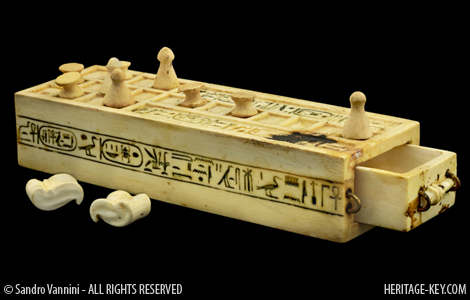
Apparently people have enjoyed playing board games for a very long time. It's interesting to find the progenitors of modern board games in Ancient Near East & Egyptian collections. The ancient Egyptian game, Senet, reminds me of a cross between cribbage and Parcheesi. We have a replica in the SS library that can be borrowed. (Directions included!) They used rib bones instead of die, and I've always appreciated that our replica game gives you the choice of wooden ribs or die. I think it's fun for the kids to figure out how many spaces to move by how the "bones" fall. We know a little more about this game, due to representations in tomb art and other ancient references, than we do about other Early Bronze games from the Ancient Near East. There's a Hounds & Jackals peg game in the Ancient Near East room at the Museum of Fine Arts, Boston that closely resembles a cribbage board. Be sure to check it out if you visit. If you would like to read more about ancient games, you may enjoy this site, featuring games played in ancient Nabatea (think Petra) and common throughout the Near East.

                      Ivory Senet game from the tomb of Tutankhamun (c.1333 BC), Egyptian Museum

Egyptian Hounds & Jackals game, Metropolitan Museum of Art

Ancient Near East game boards and pieces, Early Bronze


                                           Royal Game of Ur (British Museum) [Replica Game]

[Israeli Antiquities Authority website; The British Museum website]

Tuesday, August 16, 2011

Hebrew Word Pictures


"For as the rain and the snow come down from heaven, 
And do not return there without watering the earth 
And making it bear and sprout, 
And furnishing seed to the sower and bread to the eater; 
So will My word be which goes forth from My mouth; 
It will not return to Me empty, 
Without accomplishing what I desire, 
And without succeeding in the matter for which I sent it."
Isaiah 55:10-11

I love the word pictures of Hebrew poetry. I have much still to learn about the style, but with each new insight I gain, the more I appreciate the Psalms and other poetic sections of Scripture. I've been teaching the basics to our 5th/6th Sunday School class as part of a unit on basic hermeneutics, rules for rightly dividing God's Word. It has been quite exciting to see them catching on so quickly! I suspect their young minds are much quicker to absorb new concepts than ours often are. I especially love "the light bulb" look when they suddenly see & understand a passage in a way they had never seen it before. Up to this age, their approach to the Bible has been to consider it a collection of stories. They are more apt to view the Bible as a storybook about people who lived long ago - Moses, David, Jonah, Paul, than as a revelation of the living God, still active in the world today. By learning new skills they are awakening to the beauty of Scripture and the significance it has in their lives. 

This passage from Isaiah provides wonderful imagery of the effectiveness of God's Word by comparing it to rain and snow that falls upon the earth. "The images chosen," observes Delitzsch, "are rich with allusions. As snow and rain are the mediate cause of growth, and thus also the enjoyment of what is harvested, so also by the word of God the ground and soil of the human heart is softened, refreshed, and made fertile and vegetative, and this word gives the prophet, who is like the sower, the seed which he scatters, and it brings with it bread that nourishes the soul; for every word that proceeds from the mouth of God is bread. (Deut.8:3)"  (1)

(1) Quoted in Biblical Hermeneutics by Milton S. Terry [Eugene, OR: Wipf and Stock Publishers, 1999 (originally 1890), p.166]

For a very easy introduction to Inductive Bible Study, I recommend:

Saturday, August 13, 2011

Flavor Your Spirit with the Words of God

"Oh, that you and I might get into the very heart of the Word of God, and get that Word into ourselves! As I have seen the silkworm eat into the leaf, and consume it, so ought we to do with the Word of the Lord—not crawl over its surface, but eat right into it till we have taken it into our inmost parts. It is idle merely to let the eye glance over the words, or to recollect the poetical expressions, or the historic facts; but it is blessed to eat into the very soul of the Bible until, at last, you come to talk in Scriptural language, and your very style is fashioned upon Scripture models, and, what is better still, your spirit is flavored with the words of the Lord.
I would quote John Bunyan as an instance of what I mean. Read anything of his, and you will see that it is almost like  reading the Bible itself. He had read it till his very soul was saturated with Scripture; and, though his writings are charmingly full of poetry, yet he cannot give us his Pilgrim’s Progress—that sweetest of all prose poems — without continually making us feel and say, “Why, this man is a living Bible!” Prick him anywhere—his blood is Bibline, the very essence of the Bible flows from him. He cannot speak without quoting a text, for his very soul is full of the Word of God. I commend his example to you, beloved."
Quoted from Charles Spurgeon  ["Mr. Spurgeon as a Literary Man,” in The Autobiography of Charles H. Spurgeon, Compiled from His Letters, Diaries, and Records by His Wife and Private Secretary, vol. 4, 1878-1892 (Curtis & Jennings, 1900)]

Suggested updated versions of John Bunyan's Pilgrim's Progress, as well as the original, are listed below. Some of these are available in the SS Library. Just ask me!
The Pilgrim's Progress in Modern English
The Pilgrim's Progress: From This World to That Which Is to Come (illustrated)
Little Pilgrim's Progress: From John Bunyan's Classic, Helen Taylor (ages 9-12)
Dangerous Journey: The Story of Pilgrim's Progress, Oliver Hunkin (ages 9-12)
The Pilgrim's Progress (Unabridged, FREE for Kindle)


Thursday, August 11, 2011

Be an "Amazing Old Man or Woman"

Jim Elliff (Christian Communicators Worldwide) recently wrote an essay entitled, "Preparing to Be an Amazing Old Man or Woman."  There is no retirement for a Christian, so it's worth taking the time to prepare yourself to be a faithful servant of God into your senior years. It's both a great privilege and a great responsibility to be used by God at any age! Here's an excerpt...
__________________________________________________________________________________

It’s not uncommon for God to use older people. Take Caleb who fought giants as an octogenarian. Or Moses, who led a cantankerous people up to the promised land at 120. Remember Anna, the widow, who served God with prayers at the temple in Jerusalem. God delights in doing this, because it makes clear that the power for living and doing the will of God isn’t found in mere human capacity, but in God Himself. Is it possible that God could use you even more in your latter years than in the earlier ones?

1.  Learn the Bible as well as possible while you can read and think well. When you come to the latter years, you are supposed to be wise. Now, please tell me, how can you be wise without thinking God’s thoughts?
2.  Clear your conscience. Don’t harbor unresolved issues that will create worrisome trouble for you both now and later.
3.  Put love first... Jesus and the authors of the New Testament all testify to the supreme place of love in the life of true believers. It is the mark of maturity, the royal law, the perfect bond of unity. It is above all, and is the law of Christ.
4.  Be a giver... Be open-handed with your time, money, and things. 
5.  Don’t quit serving. Be an example of gracious service to God. God’s people don’t retire, but they do take different assignments. 
6.  Be an example of faithfulness. Loyalty to church... is in short supply these days. You can rectify that. Be as faithful to the gatherings and activities of the church as is physically possible. If you cannot drive, don’t feel badly about asking someone to pick you up. You can help cover their gasoline, or you can take them out to eat at times to show your gratitude. Be there even in the evening when most old folks sink into their easy chairs. What better place is there to be than in the fellowship of other believers? It will cheer your spirits, when slouching in the recliner will depress you. Teach the younger ones that they should pay any price to be with other believers. 
[The entire essay may be found here.]

Wednesday, August 10, 2011

Tang Dynasty Horses

Earlier this week I enjoyed spending the morning at the Museum of Fine Arts, Boston with my oldest grandson, Nehemiah. On the way home he declared that he and I were "museum buddies," which truly warmed his Nana's heart! When I asked what his favorite work had been, he said he liked the Tang horses best. He's almost 5 and doesn't understand much about time and ancient history, but is able to connect with certain works, which greatly pleased me. I was particularly surprised when, unable to find a certain painting by Millet shown in his book, he pointed to another work by Millet on display and said, "There's another one of his paintings." Good eye, my boy! It will be interesting to see how his interest develops.


The Tang Dynasty horses, from the early 8th Century AD, have been popular with a number of children I've brought to the MFA over the years. This may be partially due to their resemblance to several famous "Disney" horses. Since I first saw them I have been convinced that the Disney artists were often inspired by ancient Chinese drawings and ceramics. The Chinese camel ceramics also have a familiar look about them.

I thought you might enjoy taking a look at these magnificent creatures. They are quite large, almost 2 feet tall and, as Nehemiah noticed from his low vantage point, they are hollowed out. (Take a look under their stomachs if you happen to see any at a museum.)

You can take a little self tour of some of the images of horses from the MFA in various mediums by clicking here. Enjoy!
If this area interests you, I'd recommend looking for a copy of "Imperial China: The Art of the Horse in Chinese History". Amazon has reasonably priced used copies. (Click on a photo for a closer look.)


Look familiar?

Saturday, August 06, 2011

Where Infinite Value is Found

John Piper was recently the Keynote Speaker at the International Christian Retail Show for publishers & authors. He gave the following seven reasons why the Bible is of infinite value.

Many American believers are drowning in personal copies of God's Word, yet seldom open a single copy from Sunday to Sunday. They neglect to plug into our God-given source for power, a tool the Holy Spirit can use to great effect if we would only soak ourselves in it.

This is in contrast to believers around the world who hunger and thirst for God's Word. When my son spent a summer ministering in Uganda, men walked for miles and miles just to hear solid teaching and be given a Bible. A missionary friend, with New Tribes Missions in Papua New Guinea, just started teaching through Scripture, beginning with Genesis. Again, men and women are walking for miles to hear the teaching. They recognize it for what it is, the source of Truth, and it is beginning to have an affect upon them. How many people groups long for a copy of the Bible in their own language ... and you have so many available to you! Show your thankfulness by reading it, meditating upon it and obeying it!

Believers need to spend time deeply engaged with God's Word on a daily basis. "If conscience is to be directed by the Spirit of God it must be governed by the Word of God." (Mary S. Wood)  Plug into your power source!
______________________________________________________________________________________

The Bible is of infinite value ...

1.  ... because it awakens and sustains faith. 
   "So then faith comes by hearing, and hearing by the word of God."  (Rom.10:17)

2.  ... because by it we receive the Holy Spirit, who is infinitely valuable.    
    "Does He who supplies the Spirit to you and works miracles among you do so by works of the law, or by 
     hearing with faith --"  (Gal.3:5)  
     Companion Passages: "be filled with the Spirit" (Eph.5:18) / "Let the word of Christ dwell in you richly" 
     (Col.3:16) 

3.  ... because it creates and sustains spiritual life. 
     "these are written so that you may believe that Jesus is the Christ, the Son of God, and that by believing 
     you may have life in his name." (Jn.20:31)   
     "Man shall not live by bread alone, but by every word that comes from the mouth of God."  (Mt.4:4)

4.  ... because it gives hope.  
    "For whatever was written in former days was written for our instruction, that through endurance and 
     through the encouragement of the Scriptures we might have hope."  (Rom.15:4)

5.  ... because it leads us to freedom.
     "If you abide in my word, you are truly my disciples, and you will know the truth, and the truth will set 
      you free." (Jn.8:31-32) 
     "Sanctify them in the truth; your word is truth." (Jn.17:17) 
     "If you abide in my word, you are truly my disciples, and you will know the truth, and the truth will set 
      you  free." (Jn.8:31-32) 

6.  ... because by it alone can we defeat Satan. He's a real being and he's very powerful. Jesus relied 
      upon Scripture to defend Himself against him, can you do any less?
      "I am writing to you, young men, because you have overcome the evil one."  (1Jn.2:13)

7. ... because it is the source of full and lasting joy.
     "Blessed is the man who walks not in the counsel of the wicked, nor stands in the way of sinners, nor sits  
      in the seat of scoffers; but his delight is in the law of the LORD, and on his law he meditates day and 
      night. He is like a tree planted by streams of water that yields its fruit in its season, and its leaf does not 
      wither. In all that he does, he prospers."  (Psalm 1:1-3)
     "I rejoice at your word like one who finds great spoil." (Psalm 119:162)
     "for I find my delight in your commandments, which I love."  (Psalm 119:47)
     "Oh how I love your law! It is my meditation all the day."  (Psalm 119:97)
     "How sweet are your words to my taste, sweeter than honey to my mouth!"  (Psalm 119:93)

      Jesus said, "These things I have spoken to you, that my joy may be in you, and that your joy may be full."
      (Jn.15:11)


Friday, August 05, 2011

Tears of the Saints

Lift up your eyes ... make disciples ... support ... pray ... send ... go ... have an eternal perspective on your life, Christian.

Thursday, August 04, 2011

Finding Direction in Ministry

I admit to being taken aback by the tone of some of the ministry books coming out. To me, the mark of a good ministry book is the amount of focus given to rightly divided biblical truth. Am I seeing God... His beauty... His worthiness ... His infinite love and power ... what He asks of us ... the attitude and methods He requires for me to serve Him in the manner He desires? Am I being encouraged to maintain a humble attitude, a God-dependence, a self-denying manner of giving of my "self" to God and others? 

Unfortunately, many young ministry authors are choosing instead to play the "blame game"... who's fault is it? You may be familiar with this type of approach. Everything pretty much boils down to sheer failure on the part of the previous generation of parents and/or church members. The idea of a young, relatively inexperienced author setting himself up as the repository of knowledge and then proceeding to inform his audience about (1) how faithful believers of the previous generation did it all wrong, and (2) how he, the author, has the answer all of them missed, is incredibly audacious, no matter how skilled, insightful or creative he might be. Let me point out a few biblical truths we should never forget.

Truth #1: The parents and Christians of the previous generation, and the one before them, and the one before them, and so on, succeeded or failed as they remained true to God's revealed truth in Scripture. If you really want to be a godly parent or a godly servant of the Lord, then you need to really know God and His Son, Jesus Christ. Know His Word, obey it and teach it. Deny "self." Let the beauty of Christ increasingly shine forth in your attitudes, your words, your priorities and your actions.

Truth #2: Every generation has blind spots ... yours will, too. As each individual believer submits himself to the truth of God's Word, he will be renewed in his mind, which will result in a lifelong process of "putting off" wrong thinking and "putting on" God-honoring thinking.

Truth #3: The power to reach people for God, whether they are your children or those whom you minister to, resides with God. He is the One at work, He is the One calling, He is the One justifying, He is the One sanctifying ...  that He may receive all the glory. Don't be fooled into thinking it's your ideas, your skills, your abilities, your insight. You'll never survive a lifetime of faithful service if you mess this one up.

Truth #4: Developing an outlook, a worldview, a chronic attitude of finding fault will kill your own spiritual growth. Jesus wants you to keep your eyes on Him, not on the real or imagined shortcomings of others. He wants you to edify people using His Word. He wants to use you to build them up, to help them grow spiritually, to promote the unity of the body, to love the unlovely. Did you know the Greek word variously translated "exhort/ beseech/ encourage/ comfort" appears some 111 times in the New Testament? Do you want to know HOW to love, HOW to comfort, HOW to teach, HOW to impact the lives of others? Come alongside and shed the truths of God's Word into their lives! Scripture commands it again ... and again ... and again. Pray for them without ceasing. Keep your eyes upon Jesus, the Author and Finisher of your faith. Abide in the vine. Abide in the Word. That's how God says He wants you to minister. It may not sell books, but it will honor the God whom you serve.

Monday, August 01, 2011

How to Become a Better Reader

Do you read with your mind? You may be convinced that reading speed is the priority ... after all, there are so many books you want to read! Some may seek sheer, mindless entertainment, not considering that every piece of writing comes from a particular world-view which affects your thinking whether you realize it or not. Better to recognize it and be able to analyze it!
"'Every person carries in his head a mental model of the world - a subjective representation of external reality,' writes Alvin Toffler in Future Shock. This mental model is, he says, like a giant filing cabinet. It contains a slot for every item of information coming to us. It organizes our knowledge and gives us a place from which to argue. As E.F. Schumacher says, 'When we think, we do not just think: we think with ideas. Our mind is not a blank, a tabula rasa. When we begin to think, we can do so only because our mind is already filled with all sorts of ideas with which to think.' These "more or less fixed ideas" we think with constitute our mental model of the world - in other words, our world view." [James Sire]
I've read many books about how to be a discerning reader.  One of the best outcomes, I've realized, is that these skills have also helped me to become a better reader of God's Word. I'm currently rereading James Sires' The Joy of Reading (quoted above). Sadly, it's out of print. You may find a used copy on line, but be aware the binding will give way as soon as you start reading it. I've demolished two copies thus far. It's worth keeping it all together with a big rubber band, however! He does have a newer book covering the same ground, How to Read Slowly.

I thought I'd share a few of his recommendations to help get you on the road to becoming a more thoughtful, discerning reader. If you can't bear the thought of marking up a book, hopefully you will enjoy keeping a journal as you read. I've found both methods incredibly useful. One advantage to journaling is that you are able to refresh yourself to the main points of the book long after you've read it. Whether you hand write your observations & favorite quotes in a journal (I prefer spiral binding, which keeps it lying flat.) or use your laptop (easier on arthritic thumbs) ... why don't you give it a try! Remember ... it's not how fast or how many books you read, it's how well you read. These practices may slow you down considerably at first, but with a little practice they become second nature.
___________________________________________________________________________________

1. Do not try to read fast; read at your normal rate - or more slowly. Speed reading may be of value for some things, but not for reading world-viewishly.

2. Read with a pen or pencil in hand: underline passages and terms and allusions which the author seems to be most interested in. This will come in handy as you attempt to find the thesis statement and the structure of the argument.

3. If you are reading a book other than an article or essay, read the preface and any other introductory material. This will often tell you what the author thinks he is doing and may give you valuable insight into his presuppositions, the methods he employs, and so forth.

4. Use a dictionary [dictionary.com] or other reference works [wikipedia.com] for all words and concepts you do not understand. One way to increase your vocabulary is to write the definition that applies above the word itself. (Here is a side benefit: You will learn to write small!) [I highly recommend Zebra F-402 pens!]

5. Underline [or highlight] major organizational words such as first, second, etc. This will help you understand the structure of the argument. You may wish to write numbers in the margins alongside important turns in the argument so that later you can grasp the organizational flow. 

6.  After reading the essay or chapter, immediately review it and locate the thesis. Most essays or chapters contain one sentence or paragraph or brief section which says in a nutshell what is going to be discussed or has been discussed. Usually this will be either near the beginning or near the end... Underline this section(s) and write thesis in the margin.

7.  Construct and note in the margin a crude outline of the entire essay or chapter. This is to help you see the way the author argues. It may lead you to discern how he thinks and why he believes his reasons are valid... With a book it is often helpful to study the Table of Contents. Some give an elaborate breakdown of the flow of the argument.

8.  Determine the genre of the piece you are reading. Ordinarily this is easy... You know you are reading an essay, a poem, a novel, a drama and so forth... Literary forms which cross the boundaries of fiction and history, such as historical fiction novels and fictionalized history force you to ask questions about what is fact and what is imagination. [It has been my experience that the more you know about an historical period, the less you will enjoy fictionalized accounts of it. Which, I suppose, should be a warning when I read fiction about time periods I do not know so well!] You also need to be sure that you have correctly identified the writer's relation to his material. Is he being facetious, satiric, humorous or straight? The stance of the author may vary through the piece, and it's important to note any shifts in approach.

9.  Consider if and how the author has achieved his purpose. What kind of evidence does he draw on? What authorities does he cite? Which does he criticize? Why? What objections does he take into consideration? Does he refute them? How?